
您的位置: 首页 > 产品中心
SECTION 1 COMPOSITION / ANALYTES DATA
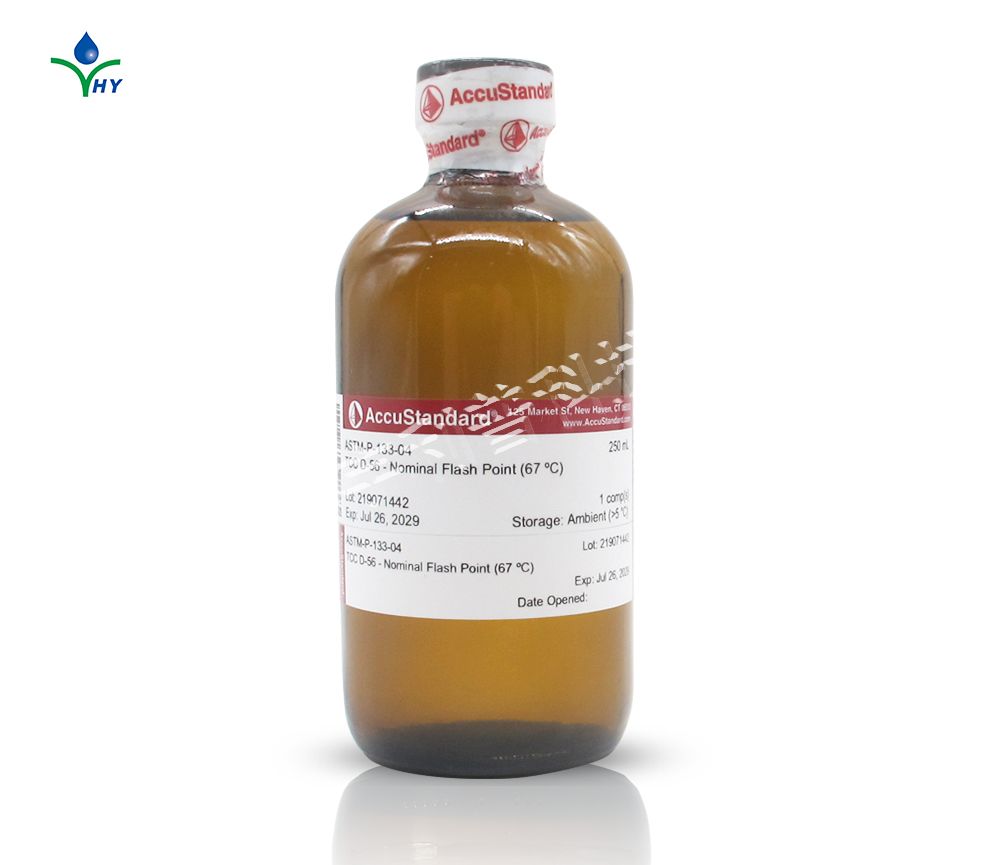
Description: TCC D-56 - Nominal Flash Point (67 ºC)
Synonyms: N/A
Molecular Weight: 156.31
Molecular Formula: C11H24
|
Analyte
|
CAS #
|
% Concentration |
|
n-Undecane
|
1120-21-4 | 100.000 |
SECTION 2 - PHYSICAL AND CHEMICAL PROPERTIES
Appearance: Clear liquid
Odor: Slight Hydrocarbon
Odor Threshold: N/A
pH: N/A
Melting Point: 14 °F / -10°C
Boiling Point: 385 °F / 196 °C
Flash Point: 149 °F / 65 °C (cc)
Evaporation Rate (Butyl Acetate=1): Negligible
Flammability Class: B-2
Lower Flammability Level: 0.6
Upper Flammability Level: 6.5
Vapor Pressure: <0.4 mmHg (20 °C)
Vapor Density (Air = 1): 5.4 g/L
Specific Gravity: 0.740 g/cm3
Solubility in Water: Insoluble
Partition Coefficient: N/A
Autoignition Temperature: 205 °C
SECTION 3 - HAZARDS IDENTIFICATION
2.1
Signal Word: Danger
Hazard Codes:
H227 - Combustible. (Flammable liquids, category 4)
H304 - Aspiration hazard if swallowed - may be fatal if swallowed and enters airways. (Aspiration hazard, category
1)
H315 - Irritating to skin. (Skin corrosion/irritation, category 2)
H320 - Irritating to eyes. (Eye damage/irritation, category 2B)
Precautionary Codes:
P202 - This product should only by used by persons trained in the safe handling of hazardous chemicals.
P210 - Store in a cool place away from ignition sources.
P233 - Store in a tightly closed container. (P404)
P260 - Do not breathe vapor.
P262 - Do not get in eyes, on skin or clothing.
2.1 - GHS Label Elements - continued
P264 - Wash thoroughly after handling. Do not take internally. Eye wash and safety equipment should be readily
available.
P280 - Protective gloves must be worn to prevent skin contact.
P284 - Respiratory Protection: If workplace exposure limit(s) of product or any component is exceeded (see
TLV/PEL), or a risk assessment shows air-purifying respirators are appropriate, use of a NIOSH/MSHA approved air
supplied respirator is advised. Use a full-face respirator with multi-purpose combination (US) or type ABEK
(EN14387) respirator cartridges in absence of proper environmental control. Always use respirators and
components tested and approved under appropriate government standards such as NIOSH (US) or CEN (EU).
Engineering and/or administrative controls should be implemented to reduce exposure.
P331 - Ingestion: Do NOT induce vomiting. Call a physician or poison control center immediately. Give victim a
glass of water a little at a time. Never give anything by mouth to an unconscious person. If vomiting occurs
spontaneously, lower head below waist to prevent fluid from entering the lungs.
P338 - Eye contact: Immediately flush with plenty of water. After initial flushing, remove any contact lenses and
continue flushing for at least 15 minutes. Assure adequate flushing by separating the eyelids with fingers.
P360 - Skin contact: Immediately wash skin with soap and plenty of water. Remove contaminated clothing. Get
medical attention if symptoms occur. Wash clothing before reuse.
2.2 - Other Hazards
2.2.1 - Symptom of Exposure Health/Environment
Aspiration hazard if swallowed - may be fatal if swallowed and enters airways. (Aspiration hazard, category 1)
Combustible. (Flammable liquids, category 4)
2.2.2 - Potential Health Effects
Irritating to eyes. (Eye damage/irritation, category 2B)
Irritating to skin. (Skin corrosion/irritation, category 2)
May be harmful if absorbed through the skin. (Acute toxicity, dermal, category 5)
Irritating to mucous membrane and upper respiratory system.
May be harmful if inhaled. (Acute toxicity, inhalation, category 5)
May be harmful if swallowed. (Acute toxicity, oral, category 5)
2.2.3 - Routes of Entry
Inhalation, ingestion or skin contact.
2.2.4 - Carcinogenicity
This product is or contains a component that is not listed (ACGIH, IARC, NTP, OSHA) as a cancer causing agent.


